If nobody can talk about your strategy, is it even working?
A strategy only comes alive when other people can interpret and act on it. With a learning strategy, and the vision that stands behind it, the L&D team need to bring the narrative to the organisation in a way people can easily interpret, act on and talk about. Otherwise, you will find variations in how it lands, how it is understood, and what people actually do as a result. Communicating the message is as important as deciding what goes into the strategy.
One person alone doesn’t bring a strategy alive. A whole organisation has to get behind it to ensure it lives and breathes. Unlike other areas of business, where people stay in their lane because they are not accountants, sales people, or ops, people often feel that they know learning because they’ve been to school. What they actually know is one interpretation of learning. If we’re not clear on how we want others to visualise our strategy, we leave it open to misinterpretation and inappropriate implementation, which usually means people simply ask for a course.
How do you create a visual identity for your strategy?
When I was Lead Volunteer for Learning and Development at Girlguiding UK, I had the challenge of reaching tens of thousands of volunteers with our new L&D strategy. My team and I could not be in all of the unit meeting halls, in all of the county training days, in all of the executive team meetings to explain our strategy. We needed everyone to understand it instantly. I turned to consulting artist Simon Heath.
Simon has an amazing ear for listening and interpreting words into visuals. Our strategy was strong: multiple routes to the same organisational goal. The main problem was that we only had in-person training, delivered by 638 wonderful volunteer trainers. This created two challenges. First, there were many interpretations of policy and programme, and ‘by-laws’ had appeared as a result. Volunteers were confused, and as every girl in Guiding deserved the best programme, there needed to be only one version of the truth.
Second, all volunteer development relied on trainers and learners giving up discretionary time. The modern volunteer is a busy person, with families, jobs, and life outside of volunteering. We needed to reach them where they were, not make them drive two hours to a training and two hours back home.
For multiple routes to the same goal, it was clear that we needed to digitise our learning offer. But how would we do that without alienating those wonderful volunteer trainers? We were not sidelining in-person training. We were adding to it. But if people hear ‘we are digitising our learning,’ that can feel like a strategy to remove roles or learning approaches that they very much enjoyed.
The image Simon created let everyone see instantly that those roles were going nowhere. There was no disrespect to the history of in-person training or to the trainers who had given so much of their time. The image held that history clearly, showing a strong road already travelled, and then opened out into multiple routes to the same final goal. Each different Girlguiding Leader would be able to access learning in a way to suit their volunteering, their experience, and their lifestyle. Most importantly, all of those different pathways led to the overarching organisational strategy, Being Our Best (BOB). BOB was represented by a tent, a strong and immediately recognisable image for every Girlguiding Leader. It was easy to see yourself in our image, our strategy, whatever your role.
Off in one corner of the image was a lake, representing the ripple effects of informal learning. It acknowledged that informal learning goes on, and nodded to the variety of interpretations that existed, whilst suggesting that informal learning could not reliably led to BOB. The image showed everyone the routes to BOB instead.
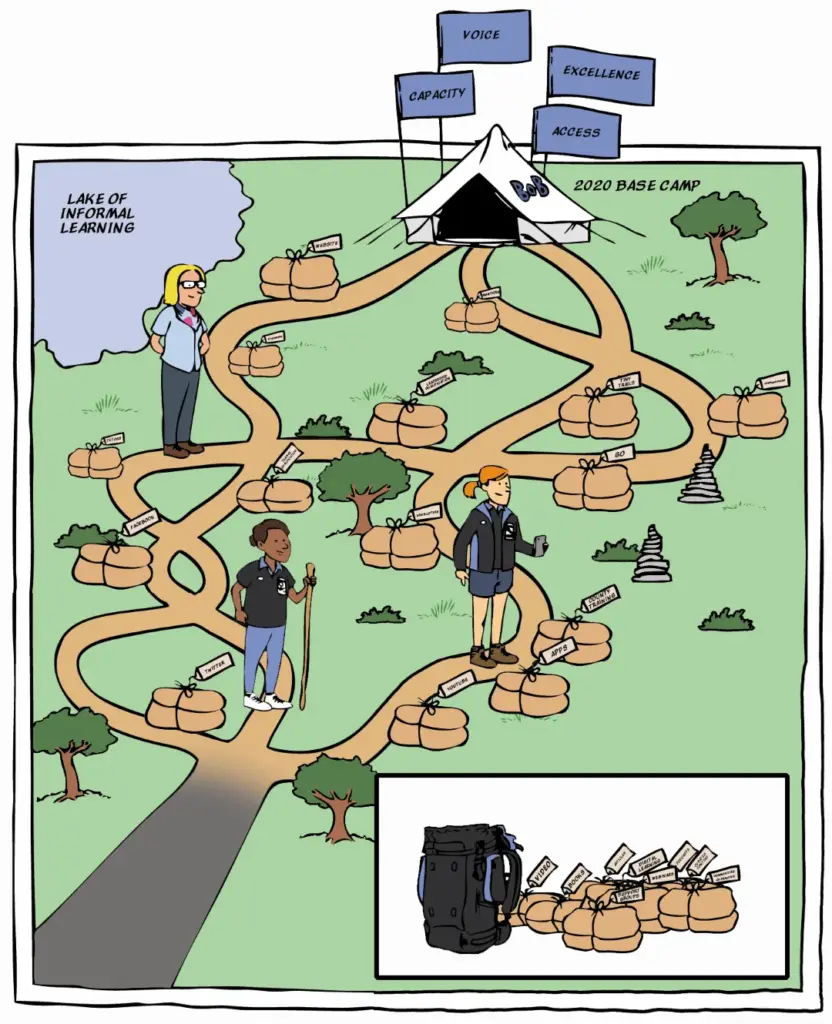
In one single glance, anybody in the organisation could understand what learning and development meant at Girlguiding. It was easy to read by everyone, regardless of their level of education, experience or familiarity with Guiding. Our team of 16 staff and volunteers could not be everywhere. But the image could and it gave people something they could hold in their heads and talk about with others. It was a cultural artefact which got people talking about our strategy, our change in approach, and actually created excitement.
Why does visual communication of your strategy work?
Cognitive psychology research has consistently shown that pictures have a significantly positive effect on four areas of communication: attention, comprehension, recall, and intention. This phenomenon, known as the Picture Superiority Effect, is well-established across decades of peer-reviewed research. A visual strategy does not just get noticed more readily, it is understood more deeply, remembered more reliably, and is more likely to move people to act.
The reason the Girlguiding image worked so well was that it spoke the language of the organisation. People could see themselves in it. It was quick to interpret for busy people, and crucially, it was easy to talk about. When busy people can talk about your strategy, they advocate for it. When it lives in a file, they don’t.
So many times, strategy is provided as a wordy document, a bulky set of slides, or Strategy On A Page (SOAP), which often means all the words are still there, simply in smaller font. What we have to remember as L&D professionals is that nobody much cares about learning except us. People care about what they are motivated or paid to care about. Give them something inaccessible and it gets quietly ignored.
When it comes to your strategy, how are you communicating it? Are you offering your organisation something they need, or something that suits you? If your strategy is stuck in a 20-page PowerPoint or a 40-page Word document, no one is ever going to look at it. Take the same care you took to design your strategy over how you communicate it.
If you need help in communicating your strategy effectively, don’t hesitate to contact us here at Learning Uncut. Get in touch.
For more on the Girlguiding case study, see Chapter 2 of my book, The Learning and Development Handbook, or listen to Learning Uncut podcast 182.
We offer a free 30-minute conversation on any aspect of L&OD. This is a genuine no-obligation conversation about your situation, with concrete recommendations. It doesn’t matter if you engage our services or not, we are here to listen.