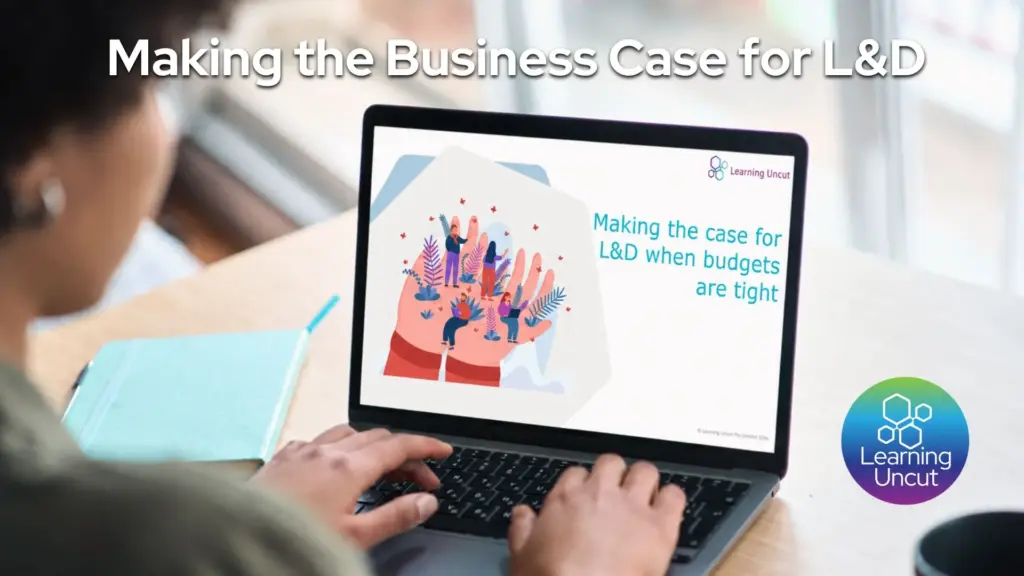
With world events and economics right now, making a business case for L&D has never felt more urgent, or more daunting. Michelle Ockers and I ran our community webinar on this very topic, once for our APAC community and again for UK and Europe. Across both sessions the live discussion and chat told us people are feeling the pressure.
Here is what we discussed in the session, grounded in research and the real experience of practitioners in the room.
Are budgets actually tight, or are we assuming?
This was our opening question. I always start with busting assumptions and moving to evidence. Starting from a place of acknowledging feelings and sensing where they are coming from helps point the direction of hard evidence. This is called recognition primed evidence. We can feel the pressure and the research backs up why.
Redundancies are real. The Global Sentiment Survey 2026 report describes this moment as possibly the most significant set of findings in the survey’s history, noting anecdotal evidence of redundancies at all levels, with paths back into new roles harder and longer than before. The CIPD’s Spring 2026 Labour Market Outlook confirms UK employers are prioritising cost management over growth as rising costs and uncertainty weigh on hiring and investment. These are not imagined pressures.
But feelings and assumptions are not a business case. Knowing the evidence-based answer to “how do you know?” is where everything really begins. It is my favourite, most important question in my performance consulting. We acknowledge our instincts, and then we need to deal in facts and in the language of our business.
Mindset is not a soft option
When we asked our webinar rooms what mindset would help them build stronger business cases, the responses were critical thinking, curiosity, a genuine orientation towards continuous improvement. I know from years of practice how easy it is to talk ourselves out of making the case at all. Bob asks for a sales course and we say yes because that is what is expected. We don’t feel we have the voice, so we don’t push back. We tell ourselves nobody really cares about L&D except us, and then act accordingly.
It is fair to say that nobody lies awake worrying about our learning culture or our evaluation frameworks. But just because others don’t expect greatness of us doesn’t mean we can’t expect it of ourselves. Saying yes without establishing the why is not the best option.
Charities are a useful case study here. They operate with almost nothing, yet they move people, change behaviour, and demonstrate impact consistently. The best of them start with a clear strategy, speak the language of their stakeholders and link every piece of their work directly to mission and outcomes. That is the mindset we can all adopt in L&D. Confident, evidence-informed, and business-first.
Demonstrating value, not just claiming it
In the webinar we ran a reverse brainstorm: if you wanted to do a really bad job of demonstrating your value, what would you do? The chat was immediately alive with recognition. Not talking about value at all. Saying yes to everything regardless of whether it aligned to any business priority. Measuring things that mean nothing to anyone outside the L&D team.
Recognise any of those? Most of us have been guilty of at least one.
Laura Overton, founder of Learning Changemakers and co-author with Michelle Ockers of The L&D Leader, has spent decades researching what distinguishes high-performing L&D teams from the rest. Her L&D Value Spectrum maps this beautifully, from learning value through to business value at the other end of the spectrum. The pattern she finds consistently is that high-performing teams start with the outputs that matter to their organisation, describe their value in the language of the business, and track progress using measures already in use across the organisation, and then look towards the other end of the spectrum. Many L&Ders start with the wrong end.
Four principles that ground a credible business case
Our discussion beyond mindset drew on Learning Uncut’s Strategy Builder programme, where our four principles underpin connected, credible business cases.
Think business first. Read your organisation’s strategy, vision and goals. Speak to people about what they actually care about. Go where they are, rather than waiting for them to come to where we are.
Start with the end in mind. Focus on a small number of significant business outcomes rather than trying to account for everything L&D does. As times get tighter, evaluation matters more, not less, because the case needs to be made visibly and consistently.
Get focused. Define the business results your work should contribute to, then identify the learning measures that serve as lead indicators. Learning measures are within your influence and are predictive. Business results are the lag outcomes that follow. Connecting the two explicitly, and being able to walk a stakeholder through that line of sight, is what turns a learning report into a business conversation.
Negotiate with the organisation. You don’t need perfect metrics. You need measures that are roughly reasonable, agreed with stakeholders, and tracked over time. Test your thinking with the people whose language you are trying to speak, and build the conversation iteratively.
One webinar participant captured this spirit perfectly in the chat: the more she asks coaching questions and respectfully challenges assumptions, the more it becomes a genuinely value-adding conversation.
Improve, not prove
Our orientation towards evaluation should be about improving our practice, with proof as the natural outcome of that mindset. That means capturing baseline metrics before any initiative begins, building measurement into our design from the start, and treating the business case not as a one-off document produced under pressure but as an ongoing conversation, updated as evidence accumulates.
One webinar participant noted where there is significant value, organisations will find the money. The business case is grounded in the relationship you build over time.
If you need a thinking partner
If you are sitting with the bones of a business case but aren’t sure how to flesh it out, here are some questions worth considering: What is the language of your business, and what do people really care about? What are you using to talk yourself out of making a stronger case? When have you taken a risk and created genuine business value, and why did it work?
If you need a thinking partner to work through these with you, that is exactly the kind of work we do at Learning Uncut. Get in touch if you missed the webinar and are keen to get the resources we shared with participants, including a success metrics template and links to relevant podcast episodes.
1 comment
Andrew Jacobs
Frustrated I couldn’t make these sessions. The principles-led approach feels exactly right.
Agreeing the principles first gives you something practical to work from. Not vague values, but the foundational elements that should inform strategy, design, delivery and evaluation. Things like being data-informed and context-led, starting with the organisational outcome rather than the learning request, and using measures that are useful to the business rather than just convenient for L&D.
Most of these principles are common sense and unlikely to get much pushback. But once they are agreed and socialised, they become useful because they give L&D permission and agency.
Permission to stop automatically saying yes to Bob’s request for a course. Agency to ask the kind of coaching questions described.
That is where the business case starts to become a way of working, not just a document.