Last month I made the case that compliance training is L&D’s shop window, and that most organisations are filling it with their worst products. I pointed to a landmark Queensland decision (Loquias v The Star Entertainment Group) confirming that tick-the-box delivery is not just bad learning practice, it may not even protect you legally. This month, I want to offer something more constructive: a different way of designing compliance training that starts with people rather than policies, that is grounded in evidence and has worked in practice across a wide range of organisations and contexts through both Learning Uncut and Kairos Modern Learning, my two consultancies. It is called the 3Rs framework, and is shared in my book, The Learning and Development Handbook.
Learning design framework, not a fixed model
The 3Rs framework is not a model for learning design that will tell you exactly what assets to build or what technology to use. All the frameworks in my book are simply a way of thinking, a lens for developing learning solutions that keeps the learner rather than the content at the centre. The 3Rs framework grew out of real consultancy work and is what I use when I sit down with an organisation to develop a learning solution: three questions that help me think clearly about what learners actually need, what would support them beyond the formal and how to build a culture in which learning becomes something people do rather than something that is done to them. In considering this design approach to rebuild your compliance training, 3Rs shows that when the organisation cares enough to get the context right, so do the people.
R1: Required, the minimum that is actually meaningful
The first R asks what is the absolute minimum a learner genuinely needs to be safe, legal, ethical and healthy in their role. Not the entire policy, not every scenario their role might theoretically encounter, but the essence: the things that, if they understand and act on them, mean they are doing the right thing.
This can be harder than it sounds, because there is a natural instinct to include everything and to feel that brevity somehow means corners are being cut. As an L&Der, telling a Risk and Governance SME you are not replicating their entire policy in a learning programme can be a tough chat. Stakeholders understandably want to see their entire policy reflected in the training. But that doesn’t work.
The question I ask of every element in a proposed compliance programme is this: does this actually meet learners’ needs, or am I including it because we’ve always included it, because the policy says so, or because the SME finds it interesting? Stripping compliance back to what is genuinely required is not about lowering standards; it is about respecting people’s time and cognitive load sufficiently to ensure that what remains is actually learned rather than skipped through on the way to the quiz. When you start with the minimum that is meaningful, people are more likely to engage with it because it feels relevant rather than overwhelming, and what remains is more likely to be retained because you have not buried the important things in a mountain of content that nobody needed.
Required is all about providing the bare minimum of what is required so people can retain and recall the essential content at the time of need to remain safe, legal, ethical and healthy in work.
R2: Resourced, supporting learning in the flow of work
The second R acknowledges a reality that classroom facilitators and elearning designers sometimes prefer not to think about: people do not do the formal learning and then go out and readily apply it. The reality is that learning happens when people encounter a situation they are not sure about, when a colleague says something that triggers a memory, or when they search for something at their desk at 4pm because they need to know right now. The Resourced element of the 3Rs is about L&D deliberately getting into those gaps rather than pretending the formal learning is sufficient. When it comes to compliance, given that formal learning is regularly sped through to simply pass the quiz, it could be argued that the endurance test of formal elearning for ticking a box is a total waste of time without resources to back it up at the point of need.
Resources can be almost anything: a checklist of what to do in an emergency, a short video that recaps the key point, a one-page guide to the most common scenarios, a series of nudges, a prompt on the intranet, a manager briefing that gives team leaders the language to have the conversation, or a FAQ built from questions that came up during the first wave of training. What matters most is that they are curated, relevant and accessible at the point of need, not a policy library or a full-length module, but a quick reference guide with the support on here is what to do when you don’t feel safe, are not sure what legal or ethical decision to make, or are struggling with your physical or psychological health due to work.
Resourced is all about providing a go-to suite of easy to use resources to upskill people in the moment when they can’t recall the essential information or need more support to remain safe, legal, ethical and healthy in work.
R3: Referred, when compliance becomes culture
This is the R that most compliance programmes never even get close to. Referred is about building a safe community around the learning and asking how we make it possible, and normal, for people to share back into their organisation what they are learning, experiencing and noticing. In a compliance context, this looks like a team meeting where a manager raises a recent industry case and asks the team how they would handle it, a colleague posting a relevant article on the internal network with a note about why they found it helpful, a story shared in a town hall about a moment when the code of conduct really made a difference, or a new policy change communicated as a conversation rather than an email with a read receipt. When this is happening, you have crossed a significant threshold: compliance is no longer the annual eye-roll elearning and test. It is part of how your organisation talks to itself. This is not easily achieved through elearning alone. It requires the organisation, particularly managers, to role-model the behaviour, create the space and treat compliance as something worth discussing rather than something to be endured.
Referred is all about making compliance everyday in lived experience for people to feel safe to ask the questions, share the near misses, learn on the job out loud, and to feel cared about by their organisation, and therefore care for themselves and their colleagues to remain safe, legal, ethical and healthy in work.
The 3Rs learning design for compliance training
When I apply the 3Rs framework to a compliance programme, the learning design questions are simple. Instead of looking at how to cram the policy into elearning, I ask:
- What is the minimum someone genuinely needs to know and be able to do in their role to be safe, legal, ethical and healthy, and how best can they experience learning that suits them?
- What will help them apply that knowledge at the moment they need it?
- How do we create the conditions for compliance to be something people talk about everyday?
This is the kind of compliance programme people actually complete, talk about at work, remember and act upon, and one a court would struggle to dismiss. Get the 3Rs right and you have solved the hardest part of the puzzle: what your people need, and how to give it to them so it sticks.
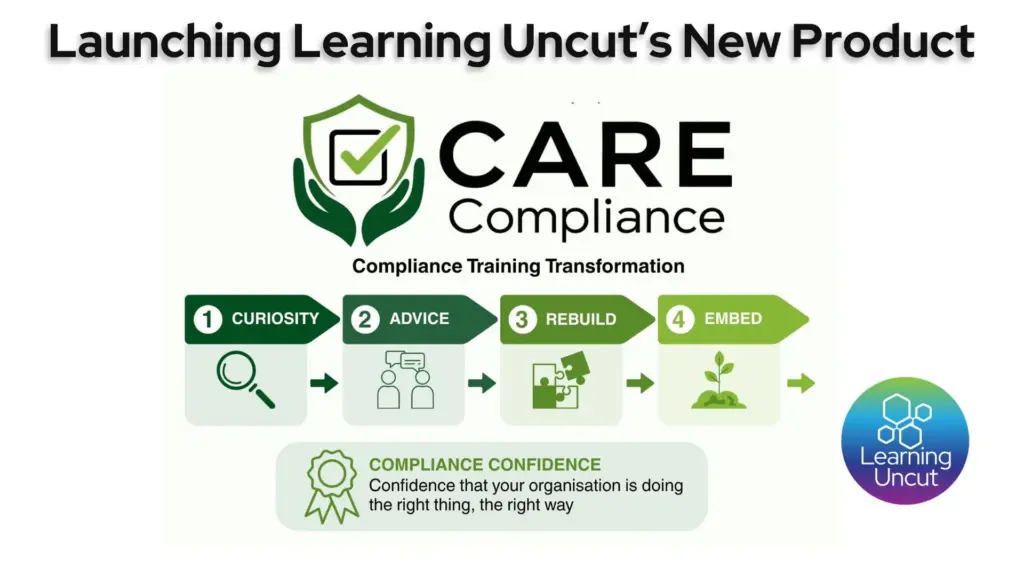
However 3Rs is the design thinking behind just one part of a bigger picture for more effective compliance training, which Learning Uncut is launching next month: CARE Compliance. Getting the content and support right is essential, but it is not the whole story, as content alone does nothing beyond box ticking, which is not legally enough anymore. Next month I will show you the rest, with examples of learning campaigns which change behaviour and produce measurable results.
If you are curious about how CARE Compliance could work for your organisation, and you don’t want to wait until next month, I would love to talk. Book a free discovery call at learninguncut.global/contact.